Somerville has been a city of immigrants since the 1800s. It has seen housing shortages, population booms and busts, industries come and go, and people move in and out.
Today, the city is going through these cycles again. New arrivals are reshaping the city’s identity, politics and infrastructure. Three Somerville residents from different walks of life give a glimpse into what the city means to them, and what they think it could be.
Evelyn Battinelli — Somerville, A City of Immigrants
Like many immigrants, it was the promise of a job that brought Evelyn Battinelli’s grandfather to Somerville.
“That’s how most of the immigrants came in the beginning,” said Battinelli. “Someone would say ‘oh yeah I can get you a job,’ and they would come. … After they got established here, then they would bring their families over.”
Both of Battinelli’s parents were immigrants. She was born in Somerville in 1938 and has lived there ever since. She worked for the Somerville Historical Society, now the Somerville Museum, for 30 years, much of that time as volunteer executive director.
Sixteen years before she was born on a lane off of Cherry Street, her father left the coastlines of Gaeta, Italy, for Somerville. He came to join his father, who had come over in the 1880s to work at the John P. Squire Company, one of the “Big Three” meatpacking factories in the city.
As these things go, said Battinelli, her grandfather had secured her dad a job in the same factory as soon as he was old enough to handle the work.
That’s the way it worked for most immigrants into Somerville, said Battinelli: “As the early people left their land, they would write back to their homes and … the connection was always someone that was here.”
Industry and Immigration
The first European immigrants to arrive were the colonists. The land first belonged to Native American tribes ruled by Nanepashemet, first husband of Squaw Sachem. After 1616, the Pawtucket tribe controlled what became Somerville. Colonists set up and settled in Charlestown in 1628, then slowly spread out to the surrounding land while the Native Americans were suffering from smallpox brought over on colonial ships.
Two hundred years and a revolution later, the land outside of Charleston that would become Somerville was home to some 1,000 people and a freight rail line. This band of farmers and Puritans decided to cut away from Charlestown, and so they founded Somerville in 1842.
America lumbered toward the new century. Somerville grew and factories cropped up. Workers were needed to fuel booming business, and they came — first Irish and Canadians, then Italians and Portuguese. Slaughterhouses and brick-making factories chugged away, dumping their disgusting waste into the small river flowing through Union Square. Boston’s streetcar system laid tracks to west Somerville in 1887, and the population boomed.
Somerville’s early industries included a pottery plant, a grist mill, a distillery, iron works, a rope manufacturer, the Fresh Pond Ice Company, the Derby Desk Company, American Brass Tube Works, a carriage manufacturer, a moulding mill, the Cushman Shade Roller Manufacturer, Carr Jewelry and Novelty Company, the Union Glass factory, and the Hurn Carpet Cleaning Company. The city was also a major brick-making site, since the land had high-quality clay, and the site of several meat packing and dressing factories. A Ford assembly plant also moved into the city later in the 1920s.
Greek immigrants arrived in the early 1900s, along with some Russians and a smattering of Armenians, Palestinians, Syrians and Turks, to try their luck in Somerville.
The boiled-down formula: “Each industry that came in brought in the immigrants that were familiar with that process,” said Battinelli. But that changed in the 1970s, when immigrants began to arrive from Brazil, Puerto Rico, El Salvador and other Central American countries, Haiti, and Vietnam and other places in Southeast Asia.
These immigrants “are more likely than any immigrant groups before them to bear the scars of political persecution, war and illegal entry,” according to a 1988 report by the city. They added 10-15,000 to the city’s population in ten years.
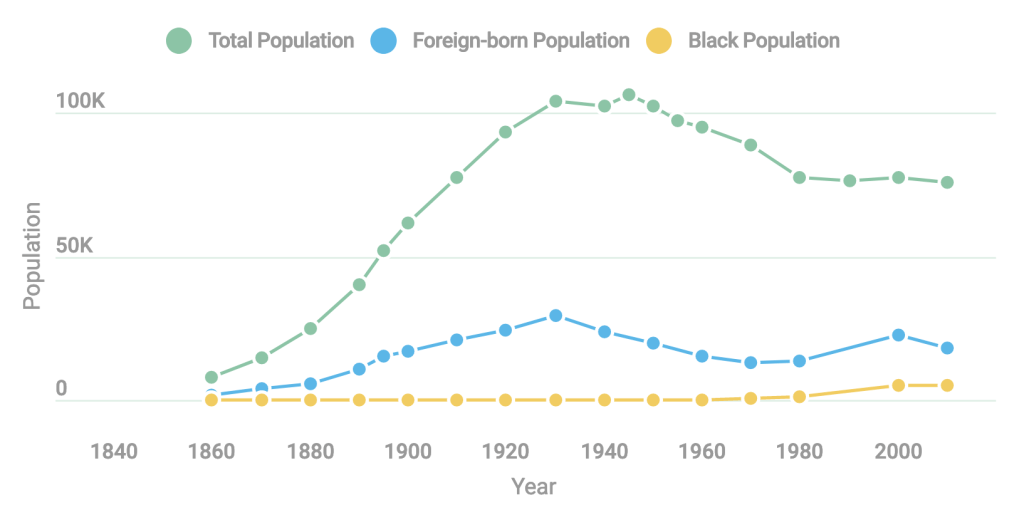
Somerville’s Black community has until recent history been small. One of the city’s first large factories, Middlesex Bleachery and Dye Works — “The Bleachery” — opened in the 1820s and printed and produced cloth from cotton harvested by slaves in the South. The factory closed in 1936.
A ‘Drastically’ Changed City
The next newcomers were immigrants of trade. Artists flocked to Somerville, attracted by cheap rent, said Battinelli, and beautified a city covered in the usual dust of industry. Meatpacking factories soaked in decades of lard had by this time caught fire and burned. Other industries moved out. In 1983 the Massachusetts Bay Transit Authority (MBTA) set up a Red Line stop in Somerville’s Davis Square. College students and young professionals caught wind of the arty, cheapish city with public transport to Boston and moved in. Housing prices shot up.
In 2020, that trend has sustained. “What we don’t have now is neighborhoods of children,” said Battinelli. “When I grew up, one little street might have 25 children on it. We don’t have that anymore, it’s not families.”
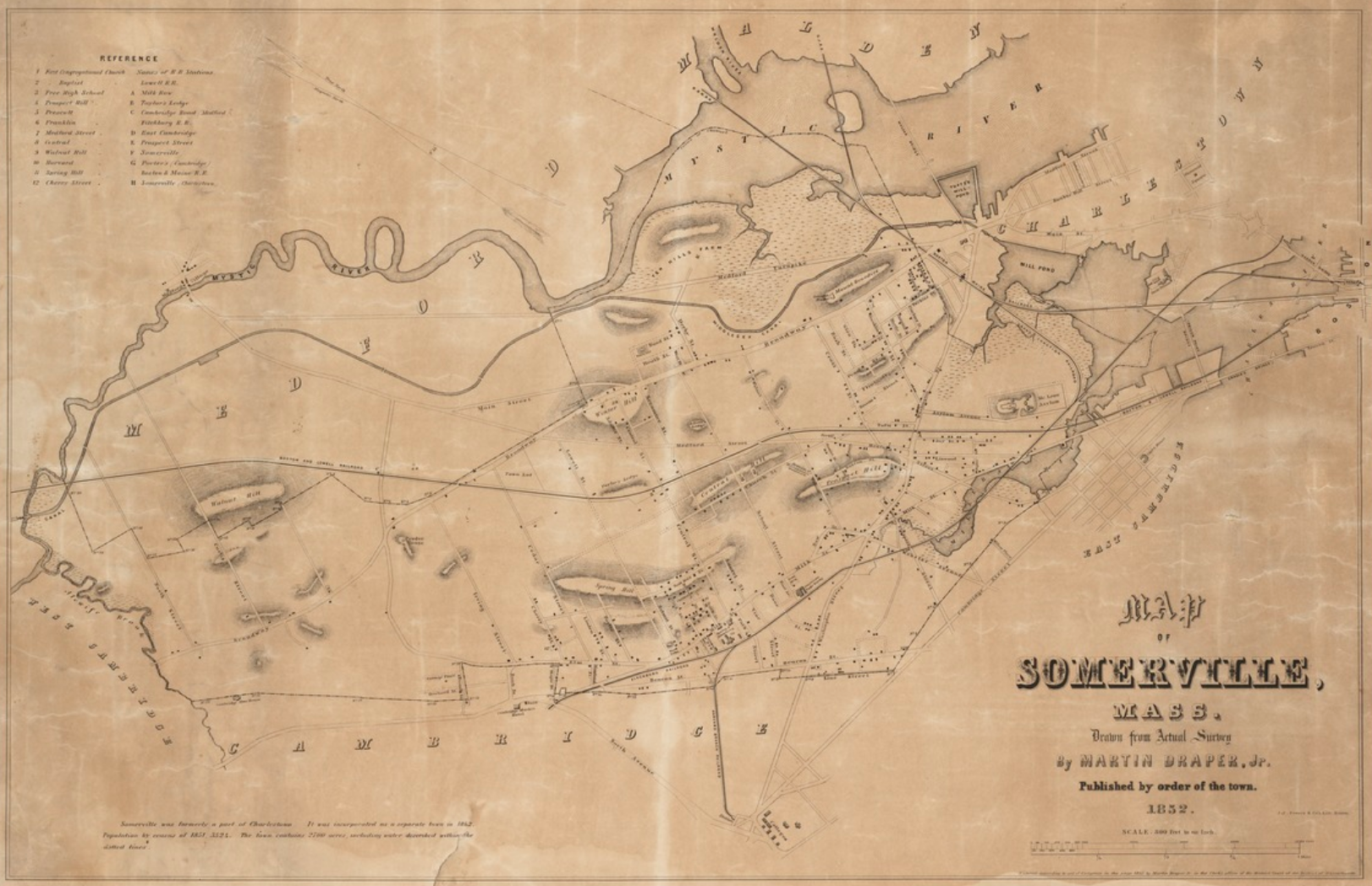
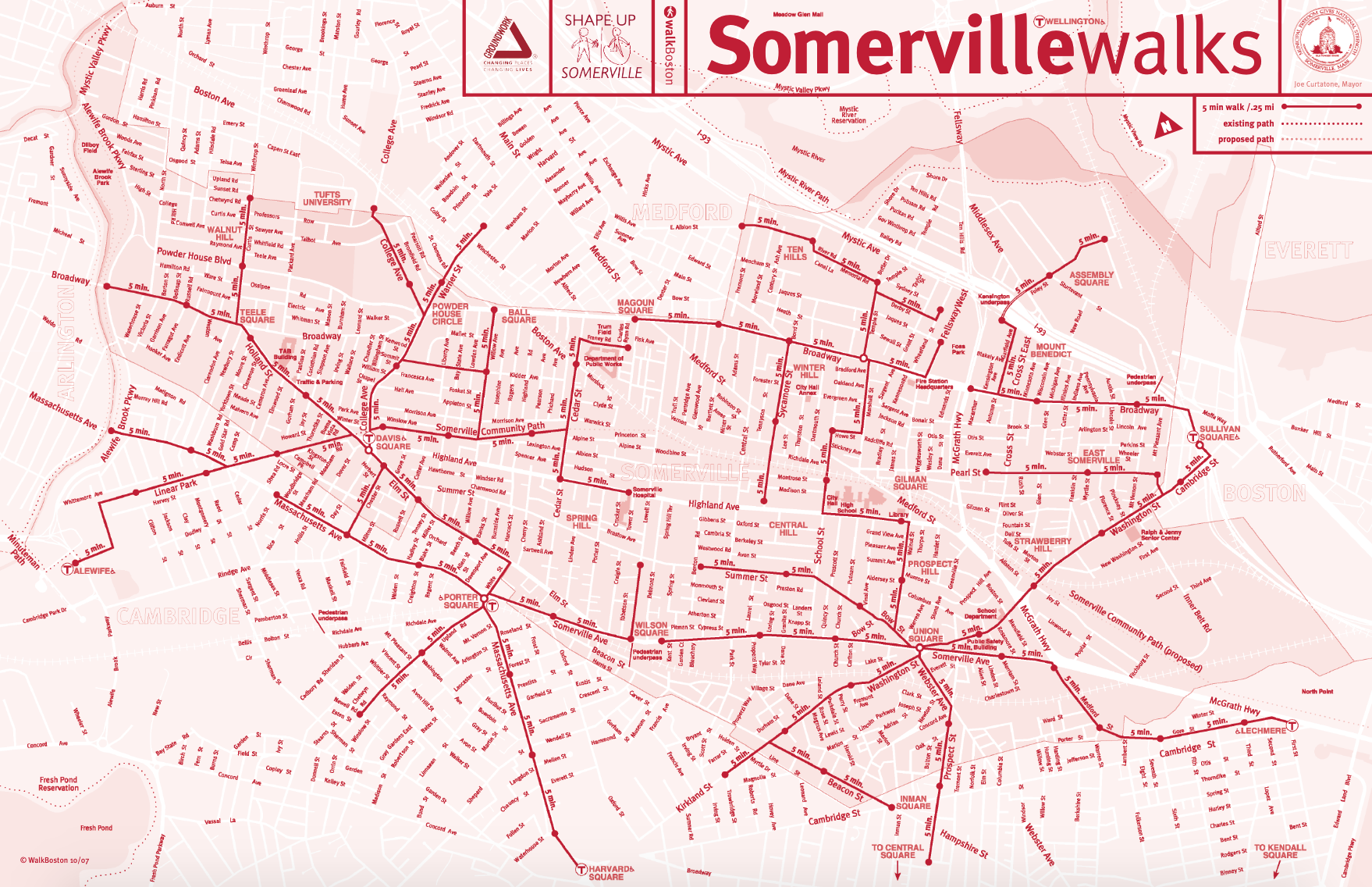
Battinelli now lives halfway between Davis Square and Union Square, at the bottom of Spring Hill. She grew up in a house five minutes away, and has watched her city change — “drastically,” she said — over 80 years. She loved it when she was a kid, and she loves it now.
But with a new MBTA stop on the horizon, and with housing prices up, some evolutions of the city are making life there too expensive for immigrants. “A lot of the children of the people who were here can’t afford to buy their family homes. They can no longer afford it.” One necessity — and historically one reason why immigrants found Somerville so enticing — is affordable housing, said Battinelli.
“It is a multicultural city right now,” she said. “That’s what we have to hope to keep.”
Historical information compiled from “American Journeys” by Joel Nitzberg, “Under the Interstate” by Carla Johnston and “City of Somerville Minority and Immigrant Needs Assessment.” Population numbers compiled from available census data and Somerville needs assessment report. Documents provided by the Somerville Public Library reference desk.
Frankie Concepcion — Building a Space for Immigrant Voices
When Frankie Concepcion moved to Boston ten years ago to go to Northeastern University, she didn’t intend to stay. But now, in 2020, she’s settled in Somerville with a successful writing career, a graduate degree in teaching and newly, her green card.
Concepcion spent six months as an undocumented immigrant waiting for her permanent resident card. But she’s wary of calling herself by that term — “undocumented.”
“Who am I to call myself undocumented when I did eventually get out of it and there are other people, their lives are defined by their undocumented status. Mine, for the most part, wasn’t,” said Concepcion.
Concepcion became an illegal resident after her status as an international student lapsed in 2019. She had to quit a job she liked, teaching at Boston Latin School. She couldn’t travel. But, “I was only waiting for my green card,” she said.
Take a look at Jose Antonio Vargas, said Concepcion. Vargas is a Filipino author, novelist and filmmaker who moved to the U.S. with his family when he was 12, without a green card. He’s also one of Concepcion’s favorite writers.
Vargas publicly came out as undocumented in 2016 after Donald Trump’s election. “That’s one person for whom there is no path to citizenship,” said Concepcion.
Her own story isn’t the type to hit the front pages, she said. “So it’s always weird calling myself undocumented when I know that this isn’t a typical undocumented immigrant experience that is talked about in the news.”
“But I think that makes it all the more important to talk about these different types of immigrant experiences, so then we’re recognizing those difficult experiences for what they are, which is an exploitation of people of color and their experiences, and xenophobia.”
‘Healing Salon’
Six months of waiting for a green card meant “my entire life had come to a standstill,” said Concepcion. She started the Boston Immigrants Writers Salon to “find a sense of purpose and meaning … and to find a community of people who had similar experiences to mine.”
She wanted stories straight from the source — “I feel like so rarely do we hear from immigrants themselves, and nuanced immigrant stories,” said Concepcion.
Fifteen people — by chance, all women — showed up to the first meeting, called “a Healing Salon,” said Concepcion. The women spoke about their homes past, present and future. There were snacks, and tears. One woman had been the keynote speaker at another attendee’s naturalization ceremony. They had never met.
“Those were the perfect stories to start a community like that,” said Concepcion.
COVID-19 has paused group meetings for now, but members keep in touch, she said.
Crossroads
Concepcion represents a lot of the demographic complexity of Somerville. She’s an artist, one of the next generation of the long-established artist community that bloomed in the Brickbottom district in the ’80s. She’s an immigrant and a woman of color, part of two groups that have always driven the city’s economy and culture. She’s also young and affluent, one of an incoming new wave of young professionals that as a group contribute to rising housing prices.
She’s aware of these crossroads. “The gentrification question is something I think about a lot,” she said. “I acknowledge that I am complicit in, and am doing my best to mitigate, the negative effects that I have on a community.”
Concepcion said she tries to support the vibrant community that makes Somerville unique, and some of that support comes from spending money.
On cuisine, for example, or artists, she said: “It shouldn’t be up to the artist to say, ‘Listen, you guys need to be paying me.’ You should just be able to say, ‘We recognize that you’re doing this work and so we’re going to pay you for it.’”
Concepcion moved to Somerville six years ago from Boston’s Back Bay. “There was just something about Somerville that I really liked. … There was a deeper-rooted sense of community here,” she said.
As for being a positive force in that community: “I’m just trying to do my best,” she said.
Ben Echevarria — Mapping Somerville’s Immigrants’ Needs
Ben Echevarria is one of the engineers behind Somerville’s progressive immigration policies. He’s the executive director of the Welcome Project, an immigrant advocacy and resource organization based in the city.
“We work well with the city. It’s not an antagonistic approach,” said Echevarria. Generally, the city is a welcoming place for immigrants, he said.
Just last year the Welcome Project with the ACLU and the Brazilian Worker’s Center created a new welcoming ordinance with the city to “uphold our values of being an immigrant-friendly city” and take away police discretion to arrest undocumented immigrants if found driving without a license, he said. An arrest lands that person on a national database accessible to U.S. Immigration and Customs Enforcement (ICE).
The city police department also will not comply with ICE officers who don’t have a warrant for arrest, and in the ’80s Somerville declared itself a sanctuary city. “The new term is a ‘welcoming city,’” said Echevarria, since the city can’t keep ICE out, said Echevarria.
The agency still has the legal right to operate in Somerville — “it is something that they can do and they do on a regular basis,” said Echevarria. “In fact they do it sometimes without telling the police department they’re coming into the city to pick people up.”
Policy Goals
Housing is another big issue facing immigrants, as the city’s population grows and housing prices with it. An incoming Green Line Massachusetts Bay Transit Authority line extension is expected to expand the population as well.
The Welcome Project is working now on an ordinance that would create a local municipal IDs for Somerville residents, giving undocumented people a government-issued identification cards. The smaller, though no less necessary, chores of Echevarria’s day-to-day include helping organize English language lessons for the non-English speaking community, acting as a referral or setting up payment plans for those who need help.
Those tasks, and broader policy goals “come from working with our immigrant community, asking them what are their needs, what do they want, and trying to make those things happen.”
The immigrant community is facing “an uphill battle,” said Echevarria, “but one that we’re able to win.”
“The immigrant population is very diverse. They make up a lot of the fabric of the city, and they want to be part of the community,” said Echevarria.
“I hope whoever wants to move in here wants to be part of the community and not make it like their old community … It needs to be something shared.”
 JULES STRUCK
You must be logged in to post a comment.